Obadiah’s Mysterious Vision – Part 4 of 4

on Saturday, August 10, 2013 by 
This 4-part study comes from the Chapter called Obadiah’s Mysterious Vision in my book called Psalm 83 – The Missing Prophecy Revealed, How Israel Becomes the Next Mideast Superpower.
It is my sincere belief that achieving a rich understanding of Obadiah’s vision requires a basic understanding of the Psalm 83 prophecy. My book, which is available for purchase at this link, is a compilation of over 11-years of research on the subject of the Psalm 83 concluding Arab-Israeli war. For information about the Psalm 83 book click here.
Onward with Obadiah’s Vision – Part 4 This study looks at Obadiah 1:15-21 (all footnotes are included in the Psalm 83 book).
For the day of the LORD upon all the nations is near; As you have done, it shall be done to you; Your reprisal shall return upon your own head. (Obad. 1:15, NKJV).
The curse-for-curse-in-kind reprisal against Edom will occur before “the Day of the LORD” occurs; it occurs when “the day of the LORD upon all the nations is near.” “The day of the LORD” is defined by most as either the entire seven-year period of the tribulation (i.e., Daniels seventieth-week), or only the second half of that period, spanning 3.5 years.
For as you drank on My holy mountain, So shall all the nations drink continually; Yes, they shall drink, and swallow, And they shall be as though they had never been. (Obad. 1:16, NKJV; emphasis added)
To “drink,” “swallow,” and “be as though they had never been,” finds association with biblical illustrations of judgment. The picture is that of a people being forcibly handed a cup containing a poisonous content. God, insuring that the intended recipients will not possess the antidote, personally conjures up this highly toxic concoction. The affected population group has done something that has greatly disturbed God, and as such has provoked upon them a divine judgment. Pertinent examples to this study can be found in Jeremiah 25:17–26, and Jeremiah 49:12.
The judgment to befall Edom will serve as a precursor to the judgment within “the day of the LORD upon all the nations.” Zephaniah 2 also makes clear that this judgment against Edom, which will also extend further into the other confederate member nations, is to serve as an example to the other nations, but more importantly it is a call to the “meek of the Earth” to get right before “the day of the LORD” occurs.
Gather yourselves together, yes, gather together, O undesirable nation [Israel today in unbelief, gathering in the land], Before the decree is issued, Or the day passes like chaff, Before the LORD’S fierce anger comes upon you, Before the day of the LORD’S anger comes upon you! Seek the LORD, all you meek of the Earth, Who have upheld His justice. Seek righteousness, seek humility. It may be that you will be hidden In the day of the LORD’S anger. (Zeph. 2:1–3, NKJV, emphasis added)
Zephaniah 2 goes on to describe the conditions subsequent to the Israeli Conquest of the Psalm 83 confederacy. For more information on the details of Zephaniah 2, refer to the Psalm 83 and the Prophets chapter contained within my Psalm 83 book.
Onward with Obadiah’s Vision
But on Mount Zion there shall be deliverance, And there shall be holiness; The house of Jacob shall possess their possessions. (Obad. 1:17, NKJV)
Though we are told in verse 16, that the Psalm 83 confederate nations first, and then the remaining nations at large in the world “shall be as though they had never been,” this will not be the case on Mount Zion! “On Mount Zion there shall be deliverance,” and holiness.
“The house of Jacob shall be a fire, And the house of Joseph a flame; But the house of Esau shall be stubble; They shall kindle them and devour them, And no survivor shall remain of the house of Esau,” For the LORD has spoken. (Obad. 1:18, NKJV)
Obadiah encapsulates the theme scattered throughout his vision; I will bring you Palestinians down (Obad. 1:4), you will be cut off (Obad. 1:5), your treasures searched out (Obad. 1:6), a trap for you (Obad. 1:7), everyone will be cut off by slaughter (Obad. 1:9,) shame shall cover you (Obad. 1:10), the forced drinking from the cup of judgment (Obad. 1:16). Obadiah in (Obad. 1:18) determines the defeat of Esau’s descendants residing within the modern-day Palestinians will be at the hands of Israel’s exceedingly great army. The use of stubble, which when lit burns entirely, evidences the theme earlier presented of the severity of this judgment against Edom.
The South shall possess the mountains of Esau, And the Lowland shall possess Philistia. They shall possess the fields of Ephraim And the fields of Samaria. Benjamin shall possess Gilead And the captives of this host of the children of Israel Shall possess the land of the Canaanites As far as Zarephath. The captives of Jerusalem who are in Sepharad Shall possess the cities of the South. (Obad. 1:19–20, NKJV; emphasis added)
In essence, Obadiah 1:19–20 implies that as a direct result of the Jewish conquest over the Palestinians alluded to in Obadiah 1:18, Israel will be significantly increased in both size and prosperity. The tiny Israel as we recognize it today will soon encompass a major portion of the Middle East, and become one of the wealthiest nations in the world.
Then saviors [yasha] shall come to Mount Zion To judge the mountains of Esau, And the kingdom shall be the LORD’S. (Obad. 1:21, NKJV)
The Hebrew word yasha can mean deliverers, victors, avengers, or saviors. What Obadiah appears to be stating in verse 21a is that from Mount Zion, Jewish sovereignty will be exercised over the conquered territory of Edom. The phrase “the kingdom shall be the LORD’S” in v21b is a probable reference to the sovereignty over the region by the Jews, as they will be known at that future point once again as “My people Israel.” Ezekiel 25:14 addresses this conquest and refers to the Jews again as “My people Israel.”
“I will lay My vengeance on Edom [the Palestinians] by the hand of My people Israel, that they may do in Edom according to My anger and according to My fury; and they shall know My vengeance,” says the LORD GOD. (Ezek. 25:14, NKJV; emphasis added)
Click HERE to read Obadiah’s Mysterious Vision – Part 1 (Commentary on Obadiah 1:1-2)
Click HERE to read Obadiah’s Mysterious Vision – Part 2 (Commentary on Obadiah 1:3-7)
Click HERE to read Obadiah’s Mysterious Vision – Part 3 (Commentary on Obadiah 1:8-14)

Obadiah’s Mysterious Vision – Part 3 of 4

n Saturday, August 10, 2013 by 
This 4-part study comes from the Chapter called Obadiah’s Mysterious Vision in my book called Psalm 83 – The Missing Prophecy Revealed, How Israel Becomes the Next Mideast Superpower.
It is my sincere belief that achieving a rich understanding of Obadiah’s vision requires a basic understanding of the Psalm 83 prophecy. My book, which is available for purchase at this link, is a compilation of over 11-years of research on the subject of the Psalm 83 concluding Arab-Israeli war. For information about the Psalm 83 book click here.
Onward with Obadiah’s Vision – Part 3 This study looks at Obadiah 1:8-14 (all footnotes are included in the Psalm 83 book).
“Will I not in that day,” says the LORD, “Even destroy the wise men from Edom, And understanding from the mountains of Esau? Then your mighty men, O Teman, shall be dismayed, To the end that everyone from the mountains of Esau May be cut off by slaughter.” (Obad. 1:8–9, NKJV; emphasis added)
Obadiah has previously stated the severity of the judgment in verse (Obad. 1:5–6) to befall Edom, and in (Obad. 1:8–9) he extends the scope even further to include the destruction of the “wise” and the “mighty men.” These mighty men “shall be dismayed” because of the slaughter that will be inflicted upon them by the exceedingly great army of Israel.
For violence against your brother Jacob, Shame shall cover you, And you shall be cut off forever. (Obad. 1:10, NKJV; emphasis added).
The reason for the slaughter is “For violence against your brother Jacob.” As stated previously this behavior provokes upon the persecutor of the Jews the curse-for-curse-in-kind clause of the Abrahamic Covenant as prescribed in Genesis 12:3. Obadiah continues in verses 11 through 14 below to outline and identify the historical crimes, whereby Esau’s descendants, the Edomites committed “violence against Jacob.” Their criminal rap sheet spans the scope of time from the Exodus to the present.
In the day that you stood on the other side. (Obad. 1:11a, NKJV; emphasis added)
The Exodus of the Jews via the route of Edom is referenced in verse 11. The Jews were disallowed by the Edomites to pass through the territory of Edom, as they were making their way into the Promised Land. The Edomite descendants of Esau “stood (their ground) on the other side” in opposition to the request of Moses to harmlessly pass through. This was the first serious offense they committed against the descendants of Jacob.
This was a slap in the face of the God of the Jews, Who had clearly evidenced His favoritism to the Hebrews. Jehovah, their God, had parted the Red Seas and conquered the Egyptian army single-handedly enabling the descendants of Jacob the freedom to migrate toward the Promised Land.
Now Moses sent messengers from Kadesh to the king of Edom. “Thus says your brother Israel: ‘You know all the hardship that has befallen us, how our fathers went down to Egypt, and we dwelt in Egypt a long time, and the Egyptians afflicted us and our fathers. When we cried out to the LORD, He heard our voice and sent the Angel and brought us up out of Egypt; now here we are in Kadesh, a city on the edge of your border. Please let us pass through your country. We will not pass through fields or vineyards, nor will we drink water from wells; we will go along the King’s Highway; we will not turn aside to the right hand or to the left until we have passed through your territory.’” Then Edom said to him, “You shall not pass through my land, lest I come out against you with the sword.” Thus Edom refused to give Israel passage through his territory; so Israel turned away from him. (Num. 20:14–18, 21, NKJV ; emphasis added)
In the day that strangers carried captive his forces, When foreigners entered his gates And cast lots for Jerusalem—Even you were as one of them. (Obad. 1:11b, NKJV; emphasis added)
Obadiah 1:11b is most likely depicting the siege in 845 BC by the Philistines. The Edomites at that time behaved indignantly to the Jews, much like the Philistines did. “Even you were as one of them.”
But you should not have gazed on the day of your brother In the day of his captivity; Nor should you have rejoiced over the children of Judah In the day of their destruction; Nor should you have spoken proudly In the day of distress. (Obad. 1:12, NKJV; emphasis added)
Obadiah 1:12 testifies of the crimes committed by the Edomites during the Babylonian period. Jerusalem and the temple were destroyed, and the Jews were carted off into seventy years of Babylonian captivity. He references three events: “the day of his captivity,” “day of their destruction,” and “the day of distress.” By ordering these episodes chronologically, Obadiah appears to identify for us the three Babylonian sieges that came against the Jewish people.
“The day of his captivity” The Babylonians, led by Nebuchadnezzar, first attacked Judah in 606 BC. This resulted in the first deportation wave of Jews into captivity. Some royal youths, including the prophet Daniel and some of his companions were relocated into Babylon. Additionally the king and his family along with many notable and skillful Jews were likewise transported out of Judah at this time.
“The day of their destruction”: In 586 BC there was a second general deportation of Jews by Nebuchadnezzar. Many more principal Jews were moved into Babylon. The first Jewish temple was destroyed, and the Babylonians confiscated many of the holy vessels at this time.
“The day of distress”: In 582 BC, the last deportation occurred. Many of the heads of families, their wives and children were exiled to Babylon because of this third Babylonian siege. Because of these three deportations, a sizeable Jewish community was established in Babylon.
Ample forewarning of the pending “day of” Esau’s twin “brother” Jacob had been given by the prophet Jeremiah, among others. The world was put on notice that the client nation Israel would be disciplined through captivity for a period of seventy years for their idolatrous practices and overall failure to honor and obey their Mosaic Law.
The Edomites “gazed on the day of your brother.” The crime of the Edomites was that rather than glean from the mistake of their cousins the Jews; they “gazed” upon them at the time of their first deportation, depicting their severe disdain toward the Jewish people. First, they “gazed” then they “rejoiced” at the events of the second deportation, and lastly they “spoke proudly” at the time of the third Jewish deportation.
Moreover, history tells us at that time that they capitalized on the captivity of the Jews by further migrating into Hebron and the surrounding areas of Israel, further homesteading the Holy Land.
You should not have entered the gate of My people In the day of their calamity. Indeed, you should not have gazed on their affliction In the day of their calamity, Nor laid hands on their substance In the day of their calamity. (Obad. 1:13; NKJV, emphasis added)
Obadiah advances the clock to the time of the Roman Empire. The phrase “day of their calamity,” used in this passage three times alludes to a completely calamitous period in Jewish history. Such was the case during the occupation of the Romans in the Holy Land. First the Edomites “entered the gate,” as exemplified by Antipater, a full blooded Idumean (Greek word for Edomite), who was established by Julius Caesar as the procurator over Judea in 47 BC. Then, Antipater’s son, Herod the Great reigned over Israel between 37 BC and 4 BC with the blessings of the Roman Empire.
Subsequently we see that the Edomites are again accused of gazing rather than gleaning: “you should not have gazed on their affliction.” They gazed during the Babylonian period, and that led to rejoicing and prideful boasting, Obadiah foretells in the Roman episode, they will likewise gaze, and then possess things of value to the Jews. One of the things most esteemed by the Jews was their second temple and all of its priestly implements. This temple became known during the Roman era as the “Herodian Temple,” named after Herod, who was not even a Jew. He was one-half Edomite, and one-half Nabatean. Herod and his court found themselves in a position to have “laid hands on their (Jewish) substance.”
You should not have stood at the crossroads To cut off those among them who escaped; Nor should you have delivered up those among them who remained In the day of distress. (Obad. 1:14, NKJV)
Obadiah identifies two groups of Jews, those who attempted to escape from the Roman destruction of AD 70 and those who remained in Israel during the destruction, “In the day of distress.” In so doing, he concludes his list of historical war crimes committed by the Edomites against their Jewish kindred.
In verse 1:14 he accuses the Edomites of attempting to hinder the prescribed disciplinary dispersion of the Jews out of Israel, into the nations of the world. They “stood at the crossroads to cut off those (Jews) among them who escaped.” The Romans destroyed Jerusalem and the second Jewish temple in AD 70. This provoked a majority of the Jewish population to scatter amongst the nations of the world. This dispersion was in fulfillment of numerous Old Testament Bible prophecies.
The irony is that the Edomites as a population were “among them who escaped.” At that time, they were identified by their Greek name, the Idumeans. Idumea was a recognized region in Southeastern Israel. The Idumeans “stood at the crossroads to cut off ” those Jews attempting to flee from Roman persecution.
A study of Hebrew history between the time of AD 33 to about AD 135 evidences a period of time whereby many Jews began to exit out of Israel into the nations of the world. The Idumeans tended to present themselves more as an obstacle to, rather than a facilitator of, that migration process. Obadiah ranks that episode of Edomite/ Idumean history as being comparable to the other war crimes on his lengthy list.
Lastly in Obadiah 1:14, not only did the Idumeans attempt to hinder the exodus of the Jews out of Israel, they “delivered up those among them who remained.” This behavior completely evidenced their adversarial attitude against the Jewish people. It served to prove that down through the ages the ancient hatred spawned by Esau against his twin brother Jacob, continued to filter on down through to his descendants, the Edomites, and Idumeans.
The pages of history authenticate and adjudicate Obadiah’s accusations. Today it is as if those very damaging pages have been reopened and are being relived through the events of the Arab-Israeli conflict. The Palestinians, who have some traces of Edomite ancestry among their ranks, continue to harbor the same ancient attitude of hatred outlined out of the annals of their history.
The atrocities of their past, combined with the catastrophes of their present seal their fate for the future! They will soon experience their ethnical demise through divine judgment. Although many suggest that the end of the Edomites came in correlation with the conclusion of Obadiah’s list of war crimes, Bible prophecy defeats that presumption. The Edomites resurface on numerous pages of end time’s prophecy.
Though it would have appeared as though they sealed their judgment from their actions in the past, that judgment has not been officially executed as of yet. The Judgment of the Edomites, who became called the Idumeans, and can now be best referred to as the Palestinians, will be judged in the fashion described in Ezekiel 25:14 and Obadiah 1:18.
“I will lay My vengeance on Edom by the hand of My people Israel, that they may do in Edom according to My anger and according to My fury; and they shall know My vengeance,” says the LORD GOD. (Ezek. 25:14, NKJV)
“The house of Jacob shall be a fire, And the house of Joseph a flame; But the house of Esau shall be stubble; They shall kindle them and devour them, And no survivor shall remain of the house of Esau,” For the LORD has spoken. (Obad. 1:18, NKJV)
Make no mistake: by his usage of “the house of Esau,” Obadiah refers to the ancient Edomites in the Hebrew language, later labeled the Idumeans in the Greek language, who are today known as the Palestinians, which is a derivative from the Hebrew word Pelesheth, the Arab term Filastin, the Latin word Palaestina, and the English word Palestine. The Palestinian trail can be traced in part back to the ancient Philistines, and the Edomite descendants of Esau.
Presently the Palestinians have picked up where the Idumean contingency of their ancestors left off. “Nor should you have delivered up those among them who remained In the day of distress.” They are still delivering up their Jewish cousins to oppressive conditions. It is as if the Jews who have returned to their motherland, are still living under persecution as in the former times “In the day of distress.”
Click HERE to read Obadiah’s Mysterious Vision – Part 1 (Commentary on Obadiah 1:1-2)
Click HERE to read Obadiah’s Mysterious Vision – Part 2 (Commentary on Obadiah 1:3-7)
Click HERE to read Obadiah’s Mysterious Vision – Part 4 (Commentary on Obadiah 1:15-21)

Obadiah’s Mysterious Vision – Part 2 of 4

n Saturday, August 10, 2013 by 
This 4-part study comes from the Chapter called Obadiah’s Mysterious Vision in my book called Psalm 83 – The Missing Prophecy Revealed, How Israel Becomes the Next Mideast Superpower.
It is my sincere belief that achieving a rich understanding of Obadiah’s vision requires a basic understanding of the Psalm 83 prophecy. My book, which is available for purchase at this link, is a compilation of over 11-years of research on the subject of the Psalm 83 concluding Arab-Israeli war. For information about the Psalm 83 book click here.
Onward with Obadiah’s Vision – Part 2 This study looks at Obadiah 1:3-7 (all footnotes are included in the Psalm 83 book).
“The pride of your heart has deceived you, You who dwell in the clefts of the rock, Whose habitation is high; You who say in your heart, ‘Who will bring me down to the ground?’ Though you ascend as high as the eagle, And though you set your nest among the stars, From there I will bring you down,” says the LORD. (Obad. 1:3–4, NKJV)
Though they are the least among the member nations of the confederacy, they are under the illusion that they are invincible. This is the result of their deluded religious thinking, “you ascend as high as the eagle; you set your nest among the stars.” By his usage of “stars,” Obadiah prompts us to recognize the Bible typology of angels. Numerous passages in the scriptures associate the angelic realm with the stars. Thus, there is a possible connection to be made between the deluded condition of the Palestinians, and their religious Islamic mindset.
Notice the decline of Edom. First they are reduced nationally in Obadiah 1:2, and then they are to be brought down spiritually in Obadiah 1:4. It is important to recognize the role of Islam as the embodiment of all the ancient hatred passed down through the ages, throughout the region, against Israel. Islam tends to encourage violence against the Jewish people.
The Islamic suicide bomber notoriously utters the chant “Allah Akbar” just before he or she blows up their intended Israeli target. This chant means Allah, their Islamic god, is greater than everything. Furthermore, remember that the predominant attitude of the Arab countries in the Middle East is to hinder the worship of Jehovah, the Old Testament God of the Jews. They generally prohibit the establishment of Jewish synagogues on Arab soil.
Onward with Obadiah’s Vision
If thieves had come to you, If robbers by night—Oh, how you will be cut off!—Would they not have stolen till they had enough? If grape-gatherers had come to you, Would they not have left some gleanings? Oh, how Esau shall be searched out! How his hidden treasures shall be sought after! (Obad. 1:5–6, NKJV; emphasis added)
Up to verse 5, Edom has been described as a confederate member “among the nations,” that would become “made small among them (the nations),” and “greatly despised,” but now in verse 5–6 Edom “will be cut off,” and “his (Esau’s) hidden treasures shall be sought after.” Obadiah warns of the severest form of judgment, thieves taking everything, grape-gatherers leaving no gleanings, and even hidden treasures sought after.
The prophet Amos tells us that there is a point whereby Edom’s punishment cannot be postponed.
Thus says the LORD: “For three transgressions of Edom, and for four, I will not turn away its punishment, Because he pursued his brother [Israel] with the sword, And cast off all pity; His anger tore perpetually, And he kept his wrath forever.” (Amos 1:11, NKJV; emphasis added)
Amos alludes to the historical hatred of the Jews by their Edomite brothers with “His anger tore perpetually,” and informs us that it continued through the ages: “And he kept his wrath forever.” From generation to generation, an enmity toward the Jews tore at the very core of Edomite existence. They never abandoned this feeling, which perpetuates even today through the Edomite remnant contingency residing within the modern-day Palestinians.
It is important to note that God does not levy punishment upon Gentile nations randomly. He judges Edom specifically for their continual assaults against the Jews. As such, they will provoke upon themselves the Genesis 12:3 clause contained within the Abrahamic Covenant, i.e., the curse-for-curse-in-kind.
The “him” that curses you in that important verse, has individual, national, and international applications. All who individually or collectively come against Israel beyond that point determined by God as acceptable will provoke the curse-for-curse-in-kind clause upon themselves.
There is a point whereby God used Gentile nations, such as in the Babylonian captivity, to serve out judgment against the Jews, and in these instances, those nations were “in exempt.” However, the minute those nations crossed beyond the acceptable point and persecuted the Jews, they were determined to be operating “in contempt” or “in excess,” and they provoked the Genesis 12:3 clause upon themselves.
All the men in your confederacy Shall force you to the border; The men at peace with you Shall deceive you and prevail against you. Those who eat your bread shall lay a trap for you. No one is aware of it. (Obad. 1:7, NKJV; emphasis added)
In verse 7 we gain the recognition that Edom, made small among the nations and greatly despised, is involved in a confederate effort, which is most likely the same confederacy described in Psalm 83:5–8.
These nations, supposedly having pledged a peaceful allegiance with the Edomites in support of the Palestinians plight, actually “force” them “to the border” (of Israel). Because the Edomites have their minds set upon their religious invincibility “Though you ascend as high as the eagle, And though you set your nest among the stars,” the Palestinians become deceived. The deception encourages them toward the border of Israel, and serves the other nations purposes to use them as their pawns. This diabolical scheme uses the Palestinians as insulation between Israel and the other confederate nations listed above.
This deception predominately started in 1967 because of the Arab defeat in the Six-Day War. At that point, the Jews expanded their borders and the Arab leaders realized they could not cut off the nation Israel militarily. Henceforth, the Arab leaders in the region adopted the unconventional strategies of terror and propaganda. Terror enabled them to conduct an ongoing war against Israel, aimed at the continued disruption of Israel’s national sovereignty. Terror also gave these Arab nations the ability to conduct this dirty war with somewhat clean hands. They found the displaced Palestinians to be great foot soldiers and human land mines, yet the Jewish blood would not blatantly appear as stains upon their national hands.
These nations opted to keep these displaced peoples deceptively deployed within the Gaza Strip, West Bank, and various border lying refugee camps. Note that all of these locations above are nearby the border of Israel. These Palestinians now breed profusely in these border-lying communities, and from their moment of birth are taught in textbooks to hate Israel.
With apparently clean hands, these nations go about the dirty business of promoting Palestinian propaganda within the international community. The three main issues that fuel the unrest in the Middle East are: Israel’s right to exist as a sovereign nation, a Palestinian state within the borders of Israel, and the rights of the Arab-Palestinian refugees at the borders of Israel to return to Israel. What to do about Jerusalem is a byproduct of these three issues. These Arab nations refuse Israel the right to exist, they demand a state for the displaced Arabs—but only within the borders of Israel—and they demand the refugees be assimilated within the borders of Israel.
Numerous studies have shown that the Arab refugees could be easily assimilated into these bordering Arab nations, but these nations make it difficult for the refugees to become citizens. All of these issues are only issues, because these Arab nations are poised to confederate in an attempt to destroy the nation Israel. This effort will fail!
This confederacy is rising into formation for the specific purposes referenced in Obadiah 1:1: “Arise, and let us rise up against her for battle.” They confederate to destroy Israel. They encourage the Palestinians toward the borders of Israel as their front line offensive, while they themselves protect their own borders.
Is this not the case today, with the Palestinians and the many refugee camps along the borders of Israel? These Palestinians have a plight, and their so-called Arab partners have fully propagandized it to their favor. For the most part, they discourage the thought that Israel has any right to exist, and encourage the thought that the Palestinians and refugees belong in Israel. They do not assimilate these peoples into their borders; rather, they promote the thought that they all belong in the land of Israel. They have encouraged the myth that Israel is the homeland of the Palestinians, whereas history suggests no such thing. The trap is that Israel has nowhere else to go and, as such, they have become a great army ready to protect the very borders at which this confederacy forces the Palestinians to remain. As quoted earlier from Obadiah 1:7:
“Those who eat your bread shall lay a trap for you.” No one is aware of it.
Ultimately, these nations will unite in a conventional military effort to destroy the nation Israel, but the “exceedingly great army” of Israel will decisively defeat these Arab nations.
The confederacy of Obadiah 1:7 is exposited upon in great detail in my article “The Palestinian Confederacy.” Click HERE to read this informative article.
Click HERE to read Obadiah’s Mysterious Vision – Part 1 (Commentary on Obadiah 1:1-2)
Click HERE to read Obadiah’s Mysterious Vision – Part 3 (Commentary on Obadiah 1:8-14)
Click HERE to read Obadiah’s Mysterious Vision – Part 4 (Commentary on Obadiah 1:15-21)

badiah’s Mysterious Vision – Part 1 of 4

n Saturday, August 10, 2013 by 
This 4-part study comes from the Chapter called Obadiah’s Mysterious Vision in my book called Psalm 83 – The Missing Prophecy Revealed, How Israel Becomes the Next Mideast Superpower.
It is my sincere belief that achieving a rich understanding of Obadiah’s vision requires a basic understanding of the Psalm 83 prophecy. My book, which is available for purchase at this link, is a compilation of over 11-years of research on the subject of the Psalm 83 concluding Arab-Israeli war. For information about the Psalm 83 book click here.
Onward with Obadiah’s Vision – Part 1 This study looks at Obadiah 1:1-2 (all footnotes are included in the Psalm 83 book).
To preface this study remember that Obadiah identifies historical and future names, places and events using the Hebrew vernacular of his day. Furthermore, he presumes that his readers possess a basic understanding of Hebrew history at the time that his vision becomes discerned. Since this vision is to be deciphered in these present times, this historical consideration is inclusive of their exodus out of Egypt, the Babylonian captivity, their centuries of worldwide dispersion, on past the rebirth of the nation Israel in 1948, and on into these modern times. The most important facts to note as his mysterious vision opens up are:
• Esau settled in the territory of ancient Edom, which is modern- day Southern Jordan, and is the patriarchal father of the Edomite peoples.
• A remnant contingency of the Edomite population can be located within the modern-day Palestinians.
• This Palestinian generation will be judged for the historical crimes their Edomite fathers previously committed and the current crimes they presently perpetrate against the Jewish people. The execution of this judgment upon the Palestinians will be delivered through the military might of the nation Israel.
The Commentary of Obadiah
A pastor once instructed his congregation to read the entire book of Obadiah before the next Sunday service. When the next Sunday arrived, he began the service by asking for a show of hands by everyone, who had read at least the first three chapters of Obadiah. He was humored to observe that several hands were raised. After letting out a laugh, he commented, “That’s funny, there is only one chapter in the book of Obadiah; what Bible were you reading from?”
Obadiah is only one chapter consisting of 21 verses, which ranks it as the fifth shortest book in the Bible. Although it is a short book, it is packed with timely prophetic information for this final generation. Unless one understands the book of Obadiah, he or she will likely lack significant understanding about the missing Psalm 83 piece of the prophetic puzzle. Below is a list of the ten shortest books in the Bible:
l. 3 John — 1 chapter, 14 verses, 299 words
2. 2 John — 1 chapter, 13 verses, 303 words
3. Philemon — 1 chapter, 25 verses, 445 words
4. Jude — 1 chapter, 25 verses, 613 words
5. Obadiah — 1 chapter, 21 verses, 670 words
6. Titus — 3 chapters, 46 verses, 921 words
7. 2nd Thess. —3 chapters, 47 verses, 1042 words
8. Haggai — 2 chapters, 38 verses, 1131 words
9. Nahum — 3 chapters, 47 verses, 1285 words
10. Jonah — 4 chapters, 48 verses, 1321 words
The vision of Obadiah. Thus says the LORD GOD concerning Edom (We have heard a report from the LORD, And a messenger has been sent among the nations, saying, “Arise, and let us rise up against her for battle.” (Obad. 1:1 NKJV; emphasis added)
Two things are declared in verse 1. First, the prophets (plural) have heard “a report from the LORD.” Second, “a messenger has been sent among the nations.” Note that the “report from the LORD” is not necessarily the message sent to the nations; rather, the message to the nations dictates the need for the report. The report is given through the prophets so that the Jewish people will know God’s response to the battle-stirring message “sent among the nations.”
We know what the message says: “And rise up to battle” (Jer. 49:14, NKJV). But who are the “We” to whom the report is given? Who are the nations “among the nations” to which the messenger has been sent? Lastly, who is “her” that these nations will attack? The prophets are Obadiah and Jeremiah. “We,” Obadiah and Jeremiah, “have heard a report from the LORD.” Obadiah echoes a report first heard by Jeremiah: “I have heard a message from the LORD, And an ambassador has been sent to the nations: ‘Gather together, come against her, And rise up to battle!’” (Jer. 49:14, NKJV).
Who are the nations “among the nations?” There are three key ways to determine what nations are “among the nations.” First, in verse 2 we are told that Edom is among these nations:
Behold, I will make you [Edom] small among the [confederating] nations; You shall be greatly despised. (Obad. 1:2, NKJV; emphasis added)
Secondly, in (Obad. 1:7)  the other nations, in addition to Edom, are assembled along with these Edomites in a confederacy:
All the men in your confederacy Shall force you [Palestinians] to the border; The men at peace with you Shall deceive you and prevail against you. (Obad. 1:7, NKJV; abbreviated with emphasis added)
Lastly, in verse 1 the mandate of the confederacy is to rise up to battle against some nation referred to as “her.” Is Edom this “her?” Scripture generally references Edom or Esau as “him” or “he,” rather than “her” or “she.” In addition, how could Edom be a member of a confederacy that was against him? Though verse 7 depicts Edom as a deceived member within the confederacy, he is still a known member of the confederacy. It is not probable that the Edomites, who are linked to the modern-day Palestinians, would rise up to battle among the confederating nations, with the nations, to extinguish their own existence.
More importantly, however, is to note that the report Obadiah hears concerns the final judgment against the Edomite peoples. Scripture points to the final judgment against the Palestinians as being leveled by one single nation—that nation is Israel. There is no scriptural basis to assume that the final destruction of the Edomite people will be at the hands of Edom itself, assembled with a multiplicity of nations.
Presently residing within the modern-day Palestinian refugees is a contingency of Edomite descendants. Therefore, this yet unfulfilled prophecy is destined to find its association with a pending judgment against the Palestinians and their neighboring Arab cohorts that support them. These nations are identified further on in this study.
So then, who is the “her” of verse 1 destined to be attacked? She comes under attack by a group of confederating nations. Since Edom is among these attacking nations, “her” must be someone the Palestinians want to destroy. Obadiah 1:10–14 tells us it is Israel that Edom antagonizes. Psalm 83:1–8 tells us that the Palestinians involve themselves in a confederacy for rising up to battle against Israel. In addition, Israel is referred to as “her” within the Bible more times than any other nation.
Thus, in summary, God gives the Jewish people through their prophets, predominately Jeremiah and Obadiah, as prescribed in the prophetic formula of Amos 3:7 an important report, the contents of which will be spelled out in Obadiah 1:1–21 and Jeremiah 49:7–22. This report from the LORD serves as God’s response to the petition of the Psalmist Asaph in Psalm 83:9-18.
Secondly, “a messenger has been sent among the nations.” Though it singles out Edom, this response also incorporates the Psalm 83:6–8 confederated member nations of Lebanon, Syria, Iraq, Jordan, Saudi Arabia, and Egypt, and the Gaza; Edom is only one member “among the nations.” We can restrict the “among the nations” grouping to those members who in Obadiah 1:7 are aligned in a confederacy with Edom.
“Arise, and let us rise up against her for battle.” Among the confederated nations, the call to battle has sounded in Obadiah’s vision of the future. The time has come for the Psalm 83:6–8 members to rise up against her, the nation Israel, for battle. The intent:
They have said, “Come, and let us cut them off from being a nation, That the name of Israel may be remembered no more.” (Psa. 83:4, NKJV; emphasis added)
Onward with Obadiah’s Vision
Behold, I will make you [Edom] small among the [confederate] nations; You shall be greatly despised. (Obad. 1:2, NKJV; emphasis added)
The report from the LORD begins by making two prophetic assertions in verse 2 regarding Edom. First, they will be reduced in national stature among the nations, and secondly they will be greatly despised.
Among the confederate nations, Edom will be the least in stature. This condition is emphasized in Psalm 83:6, whereby the Palestinians are identified as “the tents of Edom.” By the time the call to battle among the confederate nations arises, “Edom” will be “small among the nations.” The Palestinians are identified as tent dwellers, likely referring to them as a displaced population, perhaps a people without their own state. Remember that biblically, “the tents of,” typically refers to refugees, military encampments, or both.
Many consider Obadiah to be a contemporary of Jeremiah, which means his prophetic ministry flourished about the time of the Babylonian captivity. A study of the history of Edom from the time of the Babylonian captivity was given in the chapter of my Psalm 83 book called “The Whodomites, Who are the Edomites Today,” but is worth encapsulating again. The quote below illustrates the process of the national reduction of Edom, i.e., “Behold, I will make you small among the nations.” From the International Standard Bible Encyclopedia:
“They [the Edomites] gave what help they could to Nebuchadnezzar, and exulted in the destruction of Jerusalem, stirring the bitterest indignation in the hearts of the Jews (Lam. 4:21; Ezek. 25:12; 35:3ff; Ob. 1:10ff ). The Edomites pressed into the then evacuated lands in the South of Judah. In 300 BC, Mt. Seir with its capital Petra fell into the hands of the Nabateans. West of the Arabah the country they occupied came to be known by the Greek name Idumea, and the people as Idumeans. Hebron, their chief city, was taken by Judas Maccabeus in 165 BC (1 Macc 4:29, 61; 5:65). In 126 BC, the country was subdued by John Hyrcanus, who compelled the people to become Jews and to submit to circumcision. Antipater, governor of Idumaea, was made procurator of Judea, Samaria and Galilee by Julius Caesar. He paved the way to the throne for his son Herod the Great. With the fall of Judah under the Romans, Idumaea disappears from history.”
Presently, there is a group of displaced Arabs in the region fighting for a homeland. They are commonly called Palestinians. Over the past one hundred years, the international community has at various times encouraged them to resettle into their ancestral Arab lands away from what is known as modern-day Israel. However, to date these peoples are still predominately residing as refugees and are generally unable to resettle in the Arab nations.
There are numerous Palestinian refugee camps located at various locations inside the borders of Israel and her neighboring Arab countries. These countries have generally refused to assimilate these refugees into their citizenry. These displaced peoples, at least in part, likely find their ancestry traceable to the ethnic group known as the Edomites. We might infer that these displaced peoples, have been “made small among the nations.”
Click HERE to read Obadiah’s Mysterious Vision – Part 2 (Commentary on Obadiah 1:3-7)
Click HERE to read Obadiah’s Mysterious Vision – Part 3 (Commentary on Obadiah 1:8-14)
Click HERE to read Obadiah’s Mysterious Vision – Part 4 (Commentary on Obadiah 1:15-21)

troducing: Nuclear Showdown In Iran – The Ancient Prophecy of Elam

on Sunday, May 25, 2014 by 
elam 6My friend, Bill Salus, has just authored an especially fascinating book relative to our time. NUCLEAR SHOWDOWN IN IRAN: The Ancient Prophecy of Elam points to a particular prophecy in the book of Jeremiah that the author believes foretells a devastating blow to a certain part of Iran –the area of ancient Elam.
His is a book that I strongly suggest anyone who wants to probe some powerfully insightful, and, I believe, Holy Spirit Directed thought should get and study carefully.
Terry James, author and co-founder of Rapture Ready
………………………………………………………………..
This article is the introduction to the new Bill Salus book. Click HERE to Pre-order Bill’s book today!
As world leaders script the final pages of human history, events foretold long ago continue to unfold. Amidst the backdrop of global uncertainties, one thing remains unchanged.
“The end has been declared since the beginning.” (Isaiah 46:9-10)
Ancient prophecies cleverly disguised in sovereign circumstances present wisdom to the wise. To Know or not to know, this is the question.
Nuclear Showdown in Iran, The Ancient Prophecy of Elam provides the reader with invaluable insights into the nearest future. This book reveals the potential relevance of an ancient prophecy concerning Iran’s nuclear program that has been vastly overlooked. Additionally, it explores and sequences other age old biblical predictions that are also about to happen.
There is a tug of war going on in the world’s next nuclear hotspot, and it’s partially political, but mostly spiritual. While Iran’s Islamic leaders experiment with the atom, scores of their countrymen embrace its maker. There is a crisis taking place in Iran, and it’s far more reaching than the mainstream news media is reporting. Seventh Century Islam and state censored media have finally met their match in Christian satellite TV.
Have you heard that miracles, visions and dreams are occurring with regularity, causing throngs of Iranians to convert to Christianity? From approximately 500 believers in 1979, to several million today, Iran is the fastest growing evangelical population in the world. Christianity is burgeoning so rapidly that the rogue Islamic regime has instituted harsh policies intended to curb its growth.
Over the past couple of years, home churches in Iran have been closed, pastors imprisoned, and believers severely persecuted. Meanwhile, the modern marvel of satellite TV is being directed by the Holy Spirit to transform Iran into a Christian nation.
Why should you care? Perhaps because,
• Ancient predictions are unfolding in modern times,
• Present paranormal events are shaping mankind for a supernatural future,
• Advanced human technologies are being manipulated by invisible forces,
• The Middle East Theater is being staged for the final showdown between good and evil.
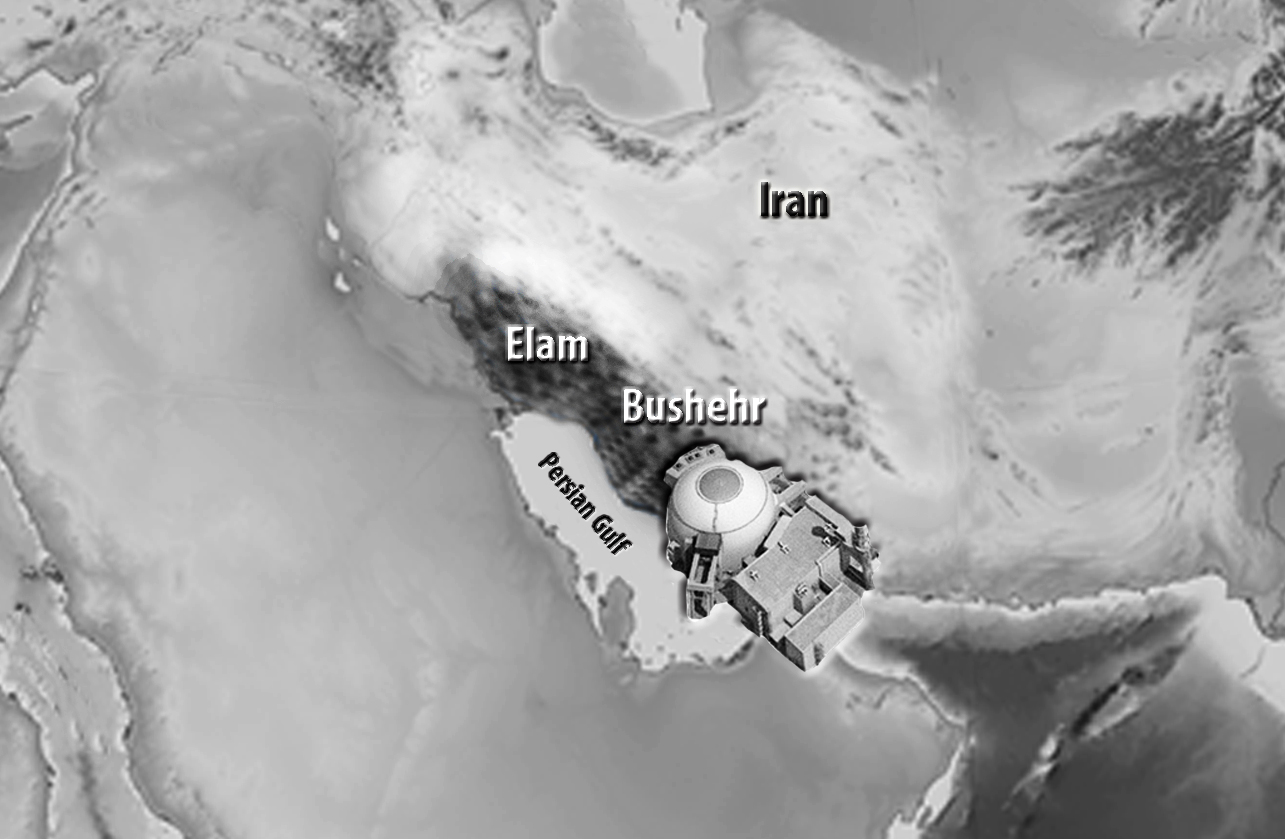
Bushehr Map
Not enough? Then what about,
• An uncontrollable nuclear arms race unleashed in the Middle East?
• Thousands of missiles launched into Israel?
• OPEC oil supplies cut off from world markets?
• Increased terrorism throughout the world?
Need more? Then imagine this,
• Gas prices hovering over $12.00 per gallon,
• Favorite public places targeted by terrorists,
• Sizeable metropolitan areas infected with incurable viruses,
• Wide scale ATM shutdowns for lack of electricity,
• NO GAS, NO MONEY, NO FOOD, NO WATER!
As you can tell by now, this is not a bestselling woman’s devotional book. However, it is a biblically based manuscript that explains the prophetic relevance of certain key current events, and deposits hope for the reader throughout.
As you traverse through these pages, you will come face to face with a generally unrevealed prophecy. Evidence will be provided that enables you to decipher whether or not this prediction is meaningful to you. Painstaking lengths have been undertaken to provide the reader with ample research to make a final determination.
In the end analysis you might conclude along with me, that the ancient prophecy of Elam predicts nothing short of a Nuclear Showdown in Iran.
****************************************************************************************************
SPIRITUAL SHOWDOWN IN IRAN VIDEO
Hormoz Shariat, the man that Bible prophecy expert Joel Rosenberg calls, “The Billy Graham of Iran,” sits down with Bill Salus to discuss the supernatural conversion of Iran into a Christian nation. WATCH THE SPIRITUAL SHOWDOWN IN IRAN INTERVIEW BETWEEN BILL SALUS & HORMOZ SHARIAT.
Hormoz Shariat is a highly educated, American Iranian. He formerly lived in Iran until the Iranian revolution of 1979. Fortunately, he had left Iran just prior to the revolution to attend an American university. He became a Christian while living in America. As a child, he was raised in a Muslim household, and prior to coming to America, he was among the throngs of Iranian Muslims that would shout, “Death to Israel, the little Satan, and Death to America, the great Satan.”
Conversely, now as a Christian that is on fire for Christ, he utilizes satellite TV as a means to spread the gospel into the Middle East. Hormoz is the founder of Iran Alive Ministries. He penetrates through the ethereal airways over the turban wrapped heads of the Islamic Mullahs, and preaches the gospel into the Farsi speaking countries of Iran, Afghanistan and Tajikistan. It is probably no coincidence that these three countries rank among the top ten of the fastest growing evangelical populations in the world. Iran is #1, Afghanistan #2, and Tajikistan #10.
To learn more about the Spiritual Showdown taking place in Iran, order your copy of Nuclear Showdown in Iran, The Ancient Prophecy of Elam. Click HEREfor more information.


Guatemalan town uses Nazi-inspired tactics to expel Jews

Guatemalan town uses Nazi-inspired tactics to expel Jews

Over 30 Jews being evicted from San Juan La Laguna at local residents' request. 'Their customs aren't like ours,' mayor says.
Peter Herriman
Published: 05.30.14, 09:13 / Israel Jewish Scene
The mayor of a Guatemalan town has made a "Jew registry," and ordered two Jewish families to leave. "Their customs aren't like ours," he insists.


The incident occurs on the heels of an Anti-Defamation League (ADL) poll revealing that anti-Semitism is a worldwide phenomenon.

Even though a focus on anti-Semitism has started in Europe and in the Middle East, at least one group of Jews in Guatemala was brave enough to speak of their own plight in the Central American press.

Anti-Semitism
Internet attacks against Czech Jews on rise / Associated Press
Though annual report suggests a rise in Internet anti-Semitism, Czech Republic compared with other countries is relatively 'quiet.'
Full story
Misael Santos, a convert to Judaism from San Juan La Laguna, told Prensa Libre that his family first moved to the area because they "wanted a clean, quiet, peaceful and friendly place for our children to grow into adults."


Unfortunately, that was not the case.


Trouble really began after Santos began a synagogue, drawing Israelis and Jewish tourists alike to the Guatemalan heartland. This Jewish increase has caused the townspeople of San Juan La Laguna to feel uneasy by the difference of another group of people with different beliefs from their own.

They've since started a petition for the small Jewish community to be evicted.

The Nazi tactics that were employed on the small Jewish community occurred when the mayor ordered "Jewish registry" to be drawn up listing the town's Jewish residents. The move was apparently to keep note of tourism in the small town, but the Jewish community became wary and it began a turn from incitement to anti-Semitic violence in a matter of weeks.

Santos states that "They uploaded photos of (Adolf) Hitler to a website about the Jews in town, saying they will put us in cremation ovens," he said. "Fifteen days ago, a group of teenagers who has read the website came up to us and began throwing stones at us."

A few days later, several children began stoning a group of women in the Jewish community, shouting "You killed Jesus!" and then one of them threw an amateur explosive device.

Santos stated, "If I go to America, I must adopt the ways of the gringo." The small Jewish community of San Juan La Laguna is not causing any problems for anyone and is just expressing their beliefs that are not hindering the lives of others.

However, the increase of a Jewish population has made the community uneasy and brought around a Nazi-like expulsion idea of the small Jewish population.


Reprinted with permission from Shalom Life .